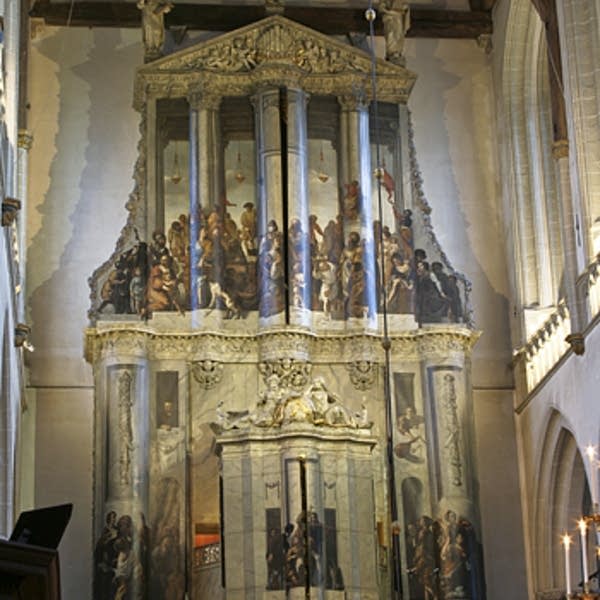
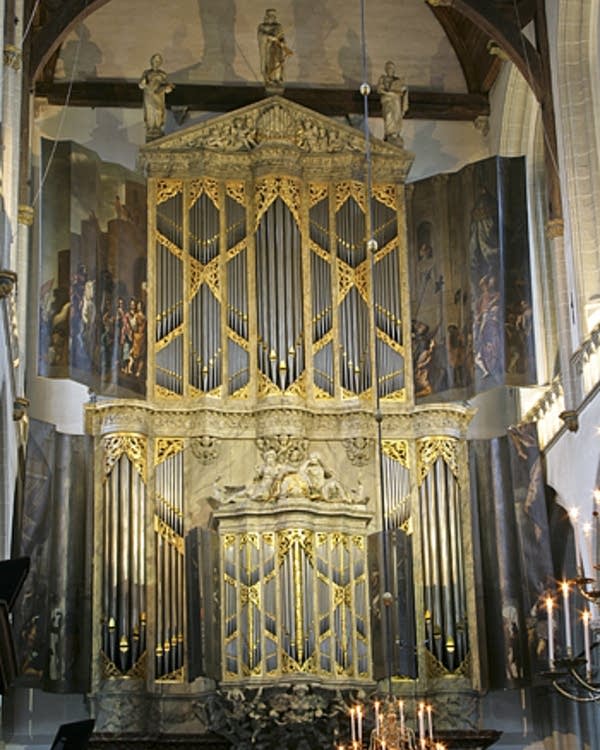
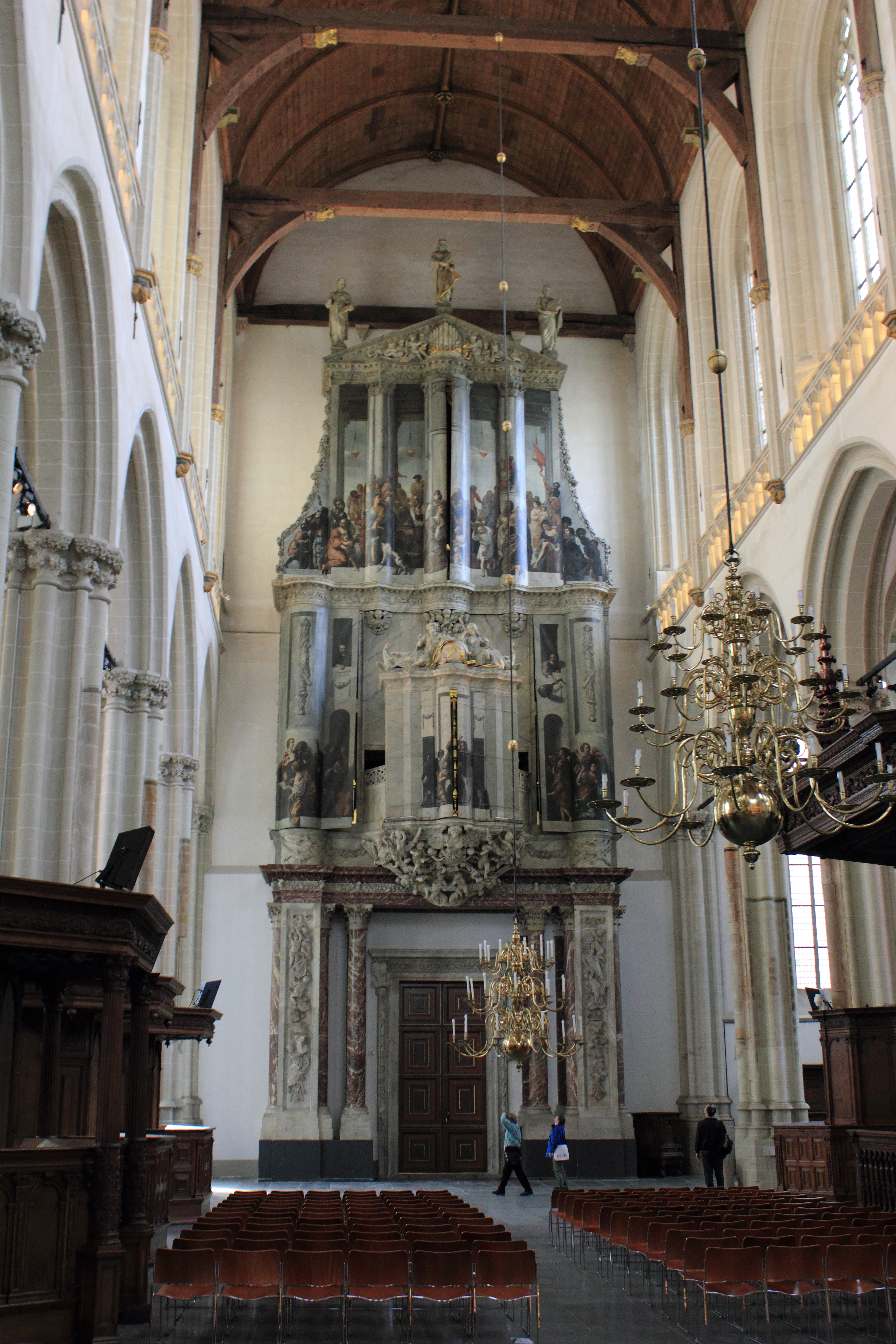
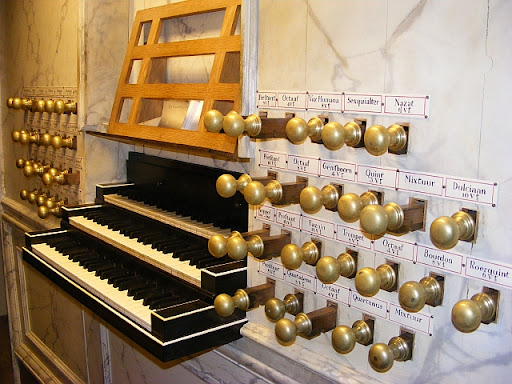
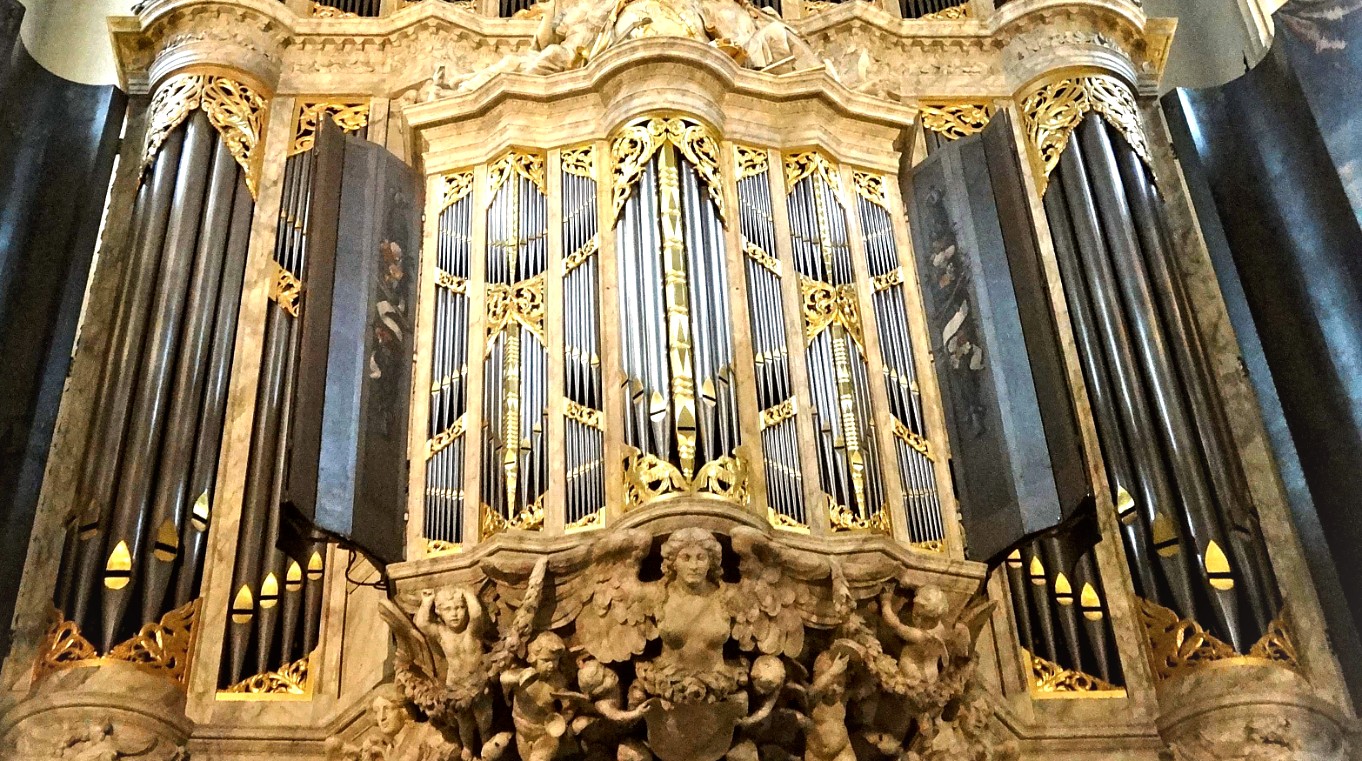
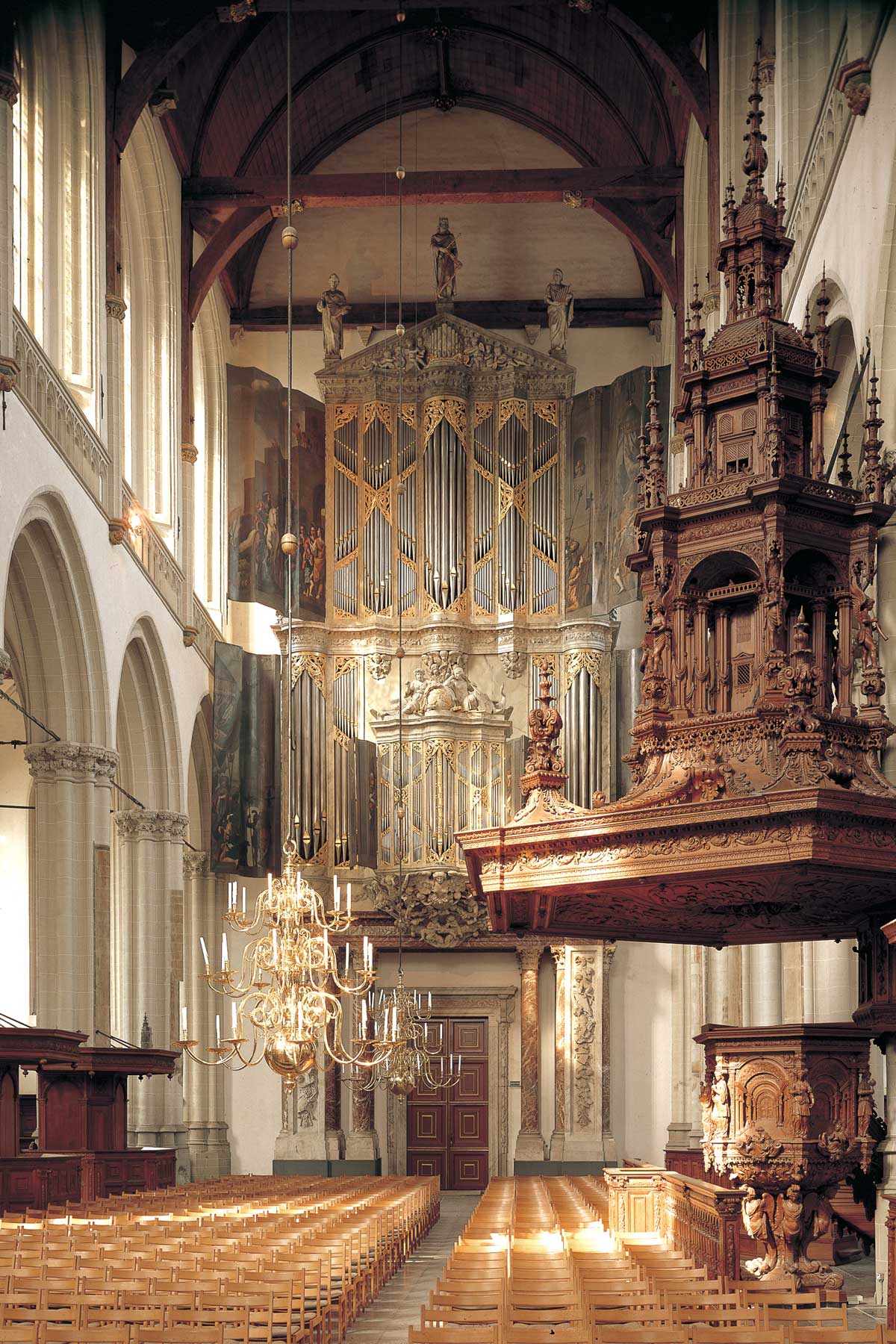
Located in the Nieuwe Kerk, Amsterdam, Netherlands. Its current disposition is three manuals and pedalboard with a total of 48 stops.
In 1650, after the reconstruction of the church hit by fire in 1645, the civil authorities aimed to acquire a new large organ. By that time, the Van Hagerbeers were working on the small transept organ and were supposed to be appointed, but Germer Galtuszn van Hagerbeer died before the building of the large organ could star. The authorities considered his younger brother Jacobus Galtuszn not experienced enough, and so they entrusted the task to Wolff Schonat from Kitzingen am Main, who achieved the new organ in 1655. Schonat’s German background left a clear mark on the organ, namely, the extension of the pedal to 11 stops, while in Dutch tradition it comprised no more than 4 stops. Notwithstanding, Schonat’s organ, with 26 stops was not to the authorities’ full satisfaction since it was not match for the church dimension. Therefore, soon after completion there was call to enlarge it. In 1688, Jacobus van Hagerbeer was finally commissioned to enlarge Schonat’s organ. He not only expanded the existing Schonat’s work, but also added a third manual with 11 stops, and stops were doubled sometimes to six ranks of pipes per key. When Jacobus van Hagerbeer died in 1670, his foreman Roelof Barentszn Duyschot took over the work and completed the organ in 1673.
The 19th and 20th centuries brough about the necessary transformations according to the taste of the time. In 1959 the church was closed due to dilapidation and the organ dismantled and stored in the Oosterkerk. Two decades later, the church was restored and the organ rebuilt by the Danish firm Marcussen & Son. The restoration involved a return to the state of just before the first 19th century transformation by Bätz (1840), applying the characteristic pipe doubling. The organ was delivered, fully functional, in 1981.
Contextual historical chronology
1675: Mathew Locke (1622-1677) Psyche.
1687: Jean-Baptiste Lully (1632-1687) Decease on March 22nd.
1689: Henry Purcell (1659-1695) Dido and Aeneas.
Click on the thumbnails to open


Listen to this organ
 sesquialteramusic