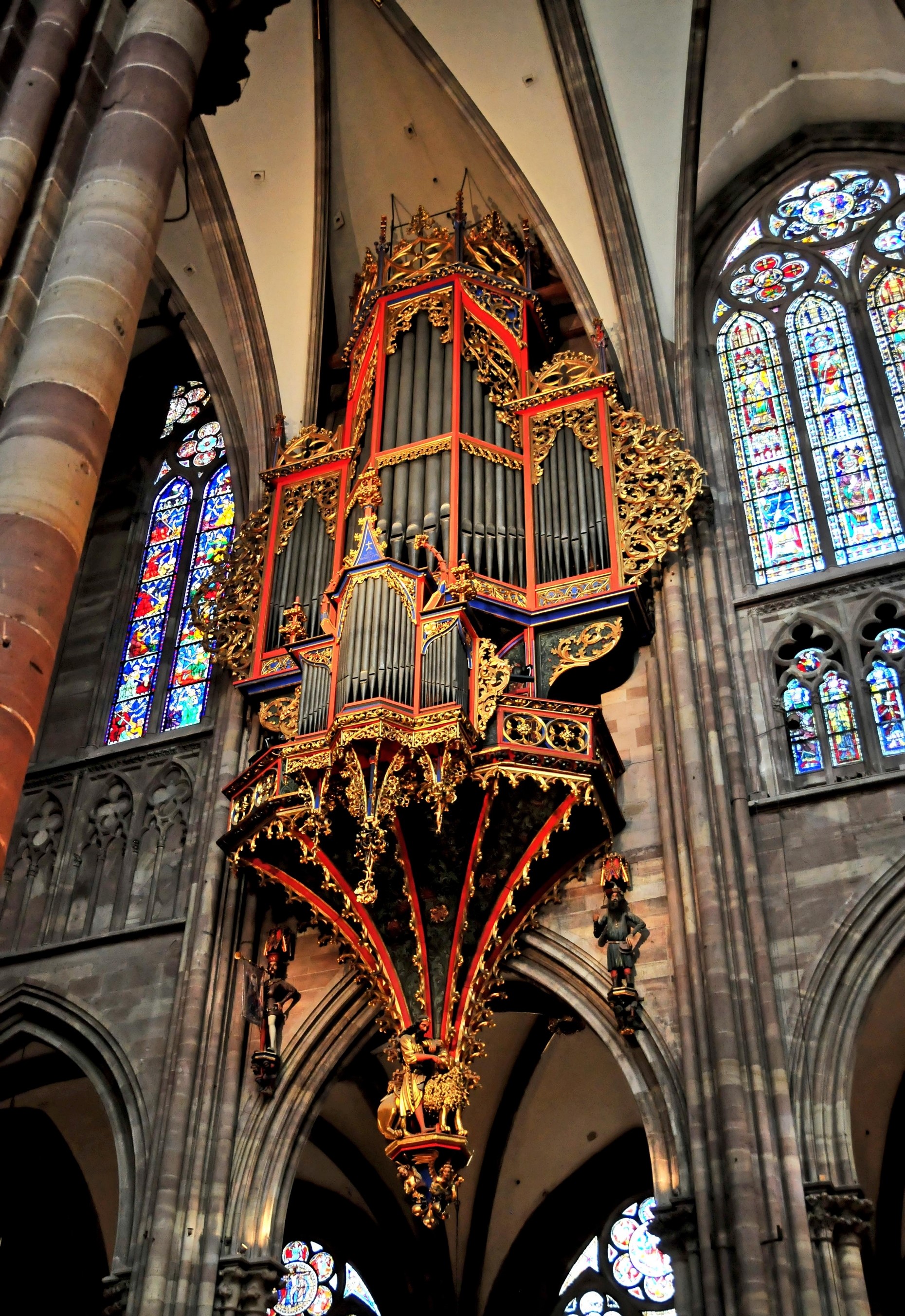
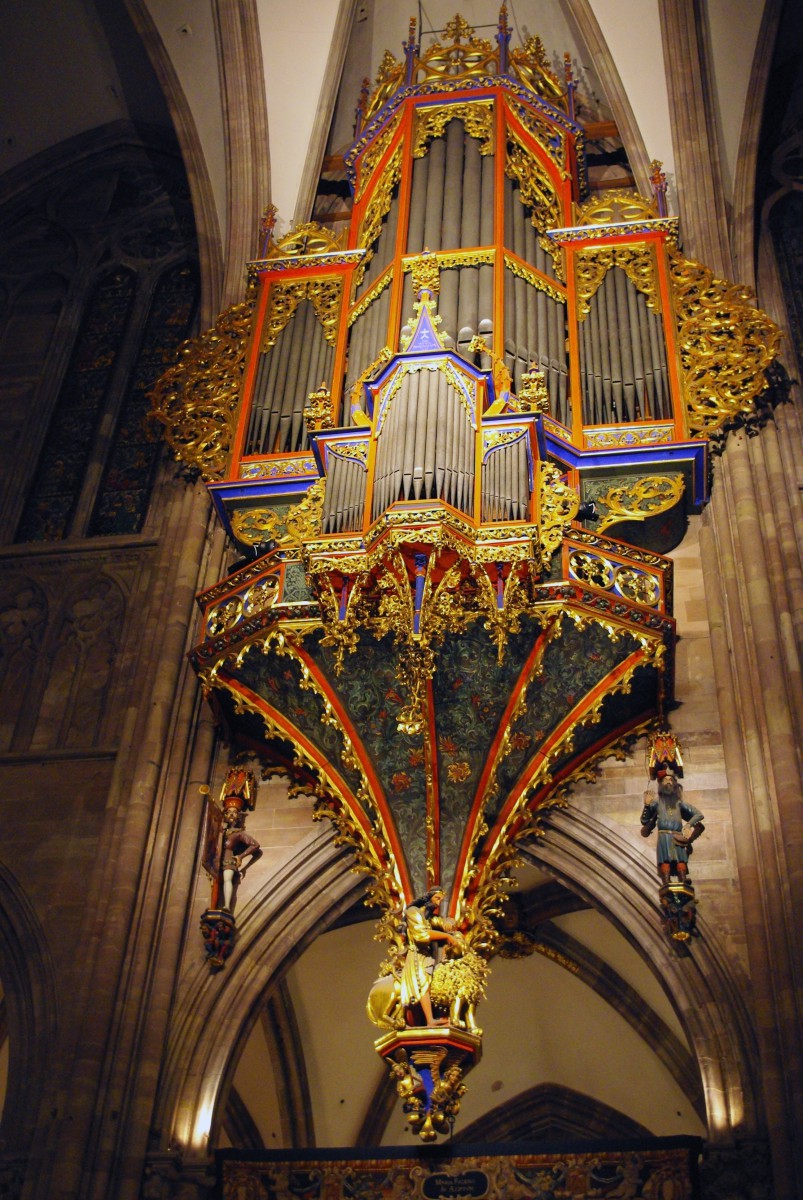
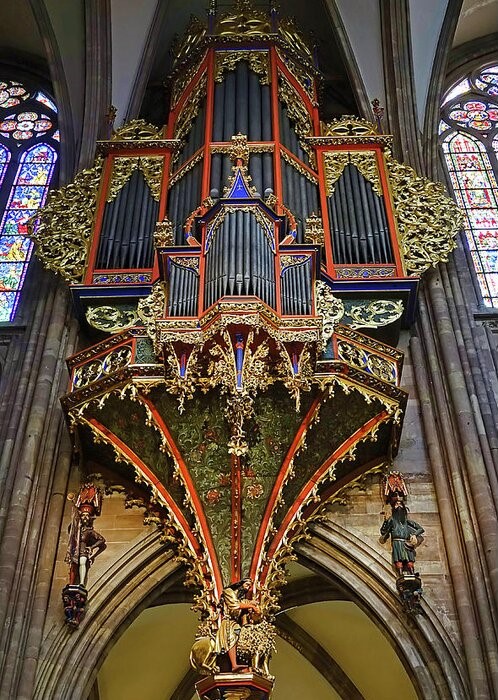
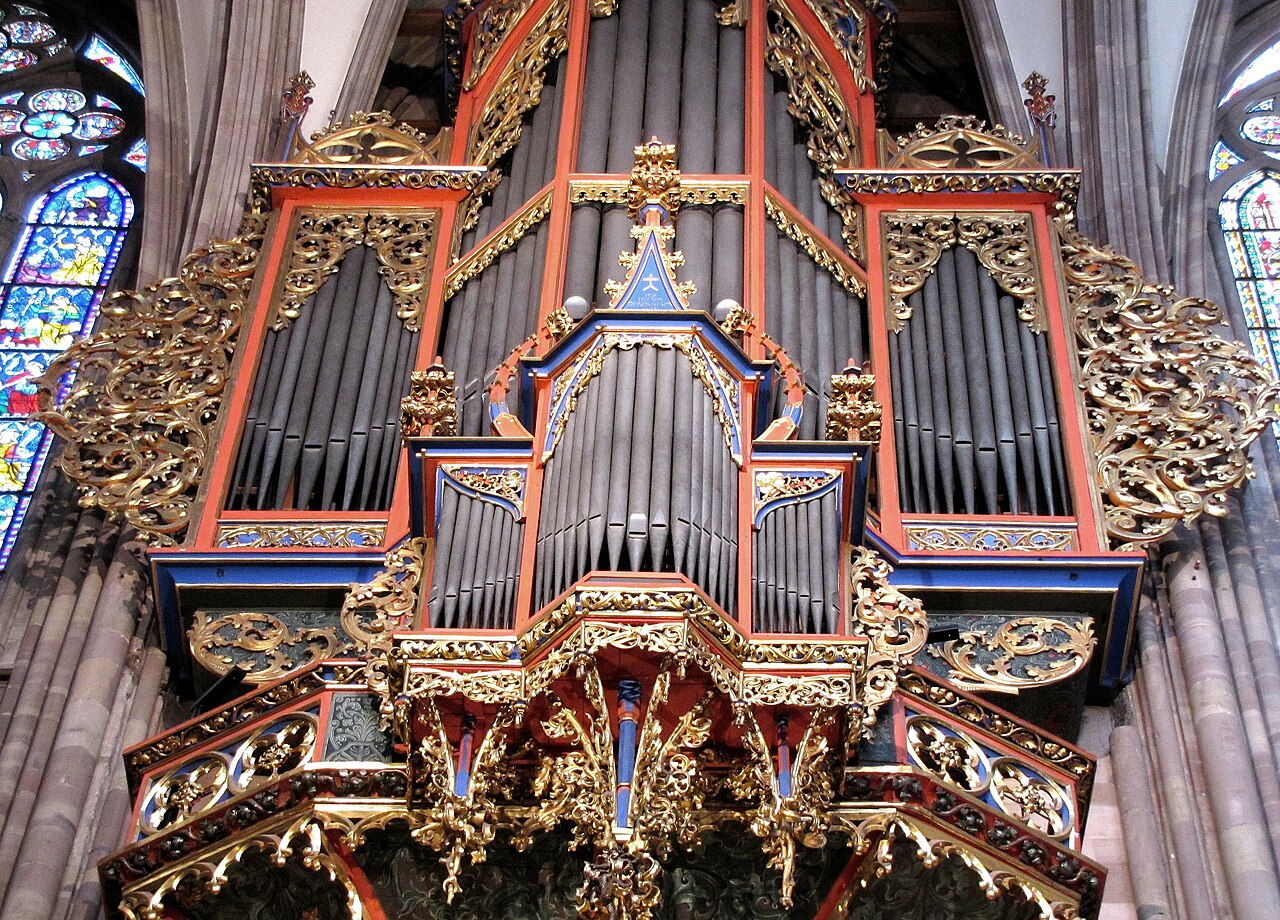
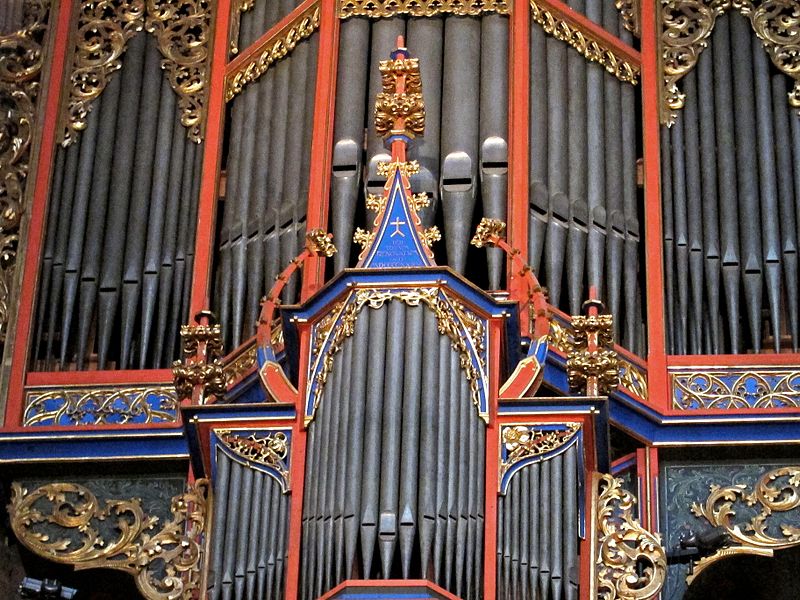
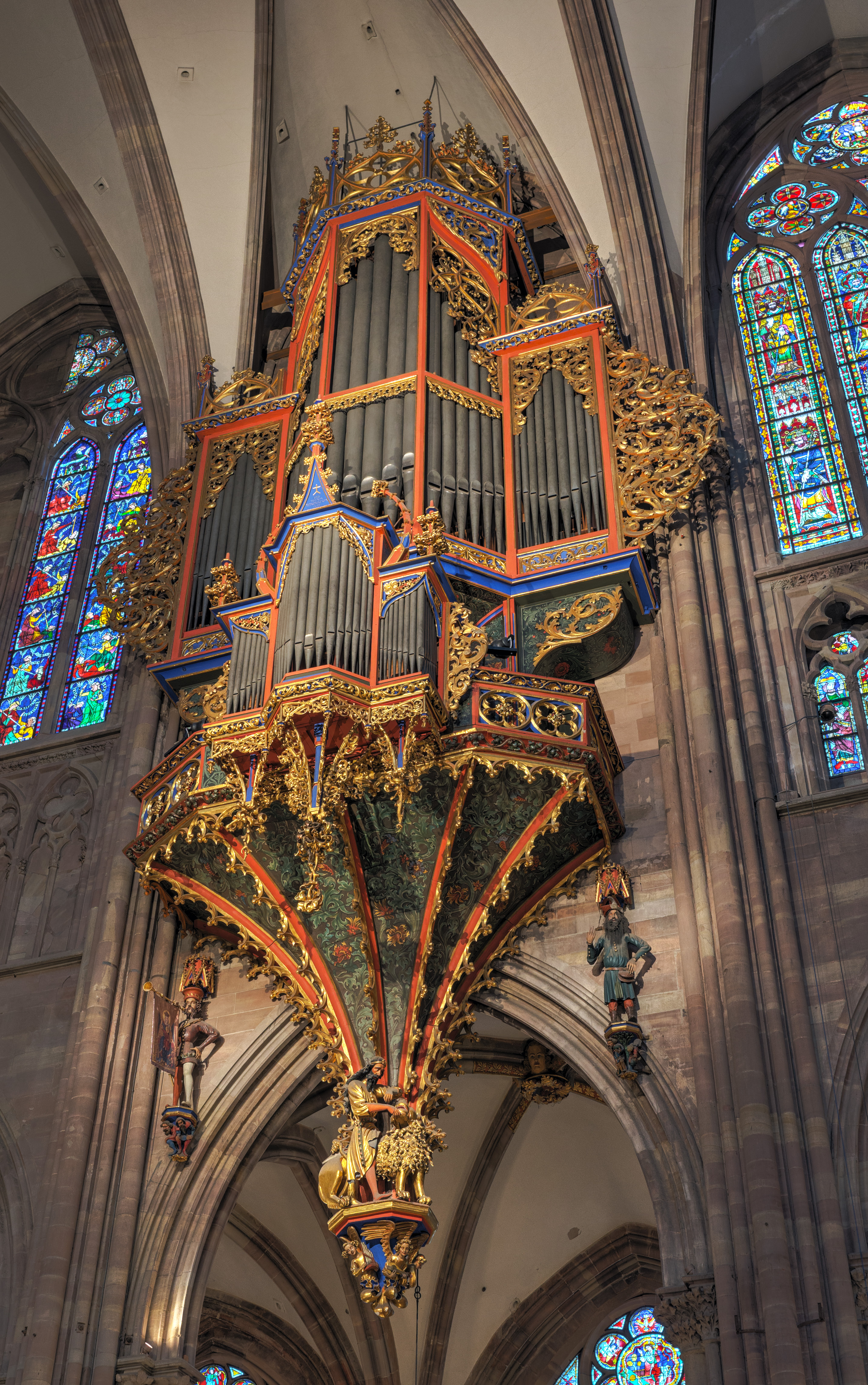
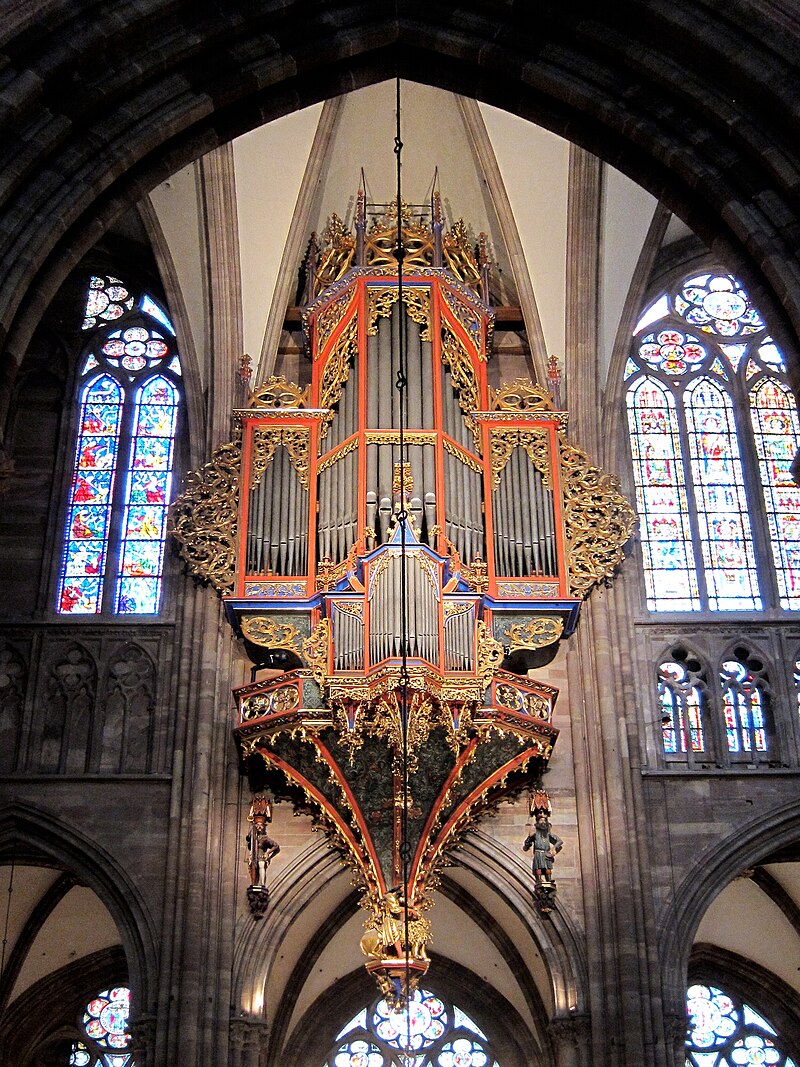
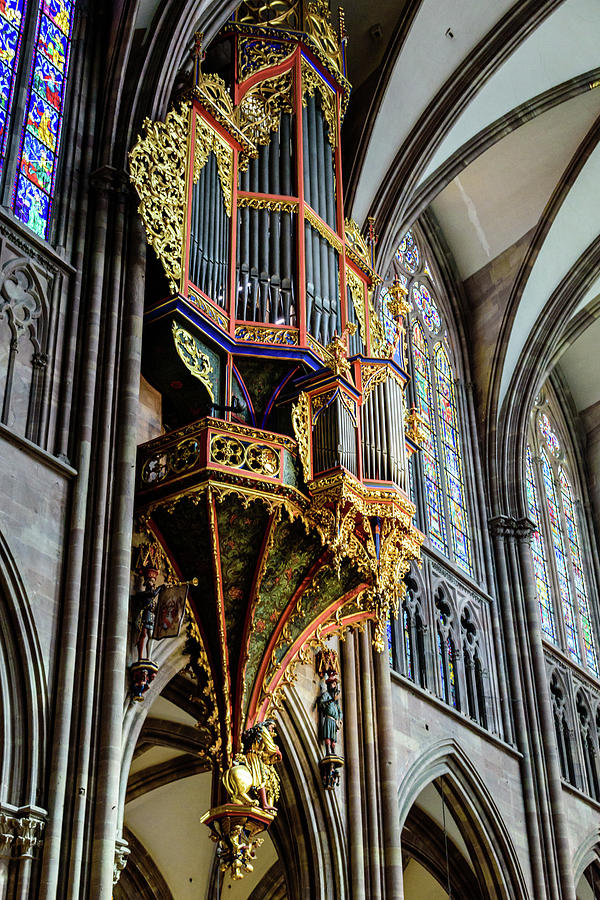
Located in swallow-nest, north to the second transept in Notre Dame Cathedral, Strasbourg, Alsace, France. Its current disposition is three manuals and pedalboard with a total of 47 stops, in original Gothic case declared historical monument in 1975.
It bears the most extricable history of all Historical Organs in France ranging from Middle Ages to the 20th century.
1260: Little organ overlooking St. John Chapel at the north transept, sponsored by the Chevalier Engelbrecht.
1292: New organ by Guncelin of Frankfort, probably placed at the present location. Consumed by fire in August 1298.
1327: New organ by Claus Karle. First fully documented organ, it was placed with certainty in the current location and with an astonishing air provision of twelve forge bellows. Destroyed by flames in 1384.
1385: New and larger organ by Conrad Rotenbourg. Pedalboard listed for the first time. Flamboyant ornamentation of the case.
1434: Reconstruction by Michael Gerlach of Leipzig, achieved by Christmas. Keeping the entire case unaltered.
1491: New organ of three manuals by the reputed builder Frederic Krebser of Alsbach. Most probably still worked “in Block” (Blokwerk). It may have counted on a gadget capable of driving the air to specific ranks (the forerunner of the stops) which allowed the keyboards to sound with different timbers.
1511: Will of renovation arose thanks to the expertise of the famous blind master of Heidelberg, Arnoldt Schlick, according to new tendencies in musical taste. Full renovation with the introduction of stops by the organ builder Hans Süss of Cologne.
1524-1542: Organ silenced by The Reformation.
1542: First restoration.
1564: Second restoration.
1609: New organ of three four octave manuals and pedalboard, with 23 stops, by Antoine Neuknecht of Ravensburg. Notwithstanding, the Haupwerk still operated in Blokwerk.
1618-1648: Looting and damages inflicted to the organ during the Thirty Years War.
1660: Repair and expansion by Mathias Tretzscher. Three manuals and two octave pedalboard, with 31 stops, extended range and suppressed Blokwek.
1681: King Louis 14th redeemed the cathedral to the Catholic cult.
1716: In 1713 Andreas Silbermann set down a rapport in which he discarded any liability of the Tretzscher organ for repair. He suggested an entirely new organ, in a new case, located in the tribune under the rose. Mainly due to budgetary issues, the cathedral imposed to him the preservation of the Gothic case and its location. Silbermann delivered his largest organ in Alsace: three manuals and pedal, 39 stops, comprising 2242 pipes.
1717: Louis Marchand played during three hours in the whole range of stops.
1833: Georges Wegmann “completed” Silbermann’s organ extending the range of the Echo and adding 5 stops. To the Haupwerk he added a Bombarde which happened to alter the overall sound balance and created problems with the air provision.
1870: Serious damages to the facility and the organ during the siege.
1873 and 1876: Repairs by Charles Wetzel.
1878: Silbermann organ altered by Joseph Merklin. Change of pitch and electrification of the console.
1897: Transformation of the Silbermann organ by Heinrich Koulen. Change of the mechanic transmission to electropneumatic, addition of 7 stops to the Positiv, 4 to the Haupt, 9 to the Recit-Echo, and 4 to the pedal. It has, now, 42 stops. Became now a symphonic organ. The job was judged as “a massacre”.
Beginning of the 20th century: Organ dismounted due to a dangerous chap on the north pillar holding the tower just before the onset of the First World War.
After the war, endeavour to endow the cathedral with a new Silbermann style organ, mainly with mechanical transmission (assisted by the Barker Machine). Ideals of authenticity and mechanic traction were on the rise. Charles-Marie Widor at the head of the committee.
1935: Alexander Roethinger was commissioned to build the desired organ. Lacking of any experience in mechanical transmission and unable to deal with the difficulties the Rückpositiv (back-organ) entailed, he swindled it by leaving the transmission of the Positiv as pneumatic. However, 250 of Silbermann’s pipes remained in the organ disposition.
1981: Alfred Kern built an entirely new mechanical organ (his last accomplishment) upon a general design by Michel Chapuis. Premiered by Gaston Litaize. It keeps 11 out of 47 original registers by Silbermann in its disposition.
Click on the thumbnails to open
Listen to this organ
 sesquialteramusic